
NetSuite Cloud ERP

One business platform, with AI built in.

If you're outgrowing QuickBooks, struggling with disconnected systems or spending too much time managing spreadsheets, NetSuite gives you the visibility, automation and intelligence you need to scale with confidence.

Based on our experience, it's a strong fit for product-based businesses with increasing operational complexity.

Talk to a NetSuite ExpertSee NetSuite Pricing
Man using phone with KPIs and NetSuite Solution Provider logo

Trusted by growing Canadian companies

What is NetSuite?

NetSuite is a cloud ERP platform that connects key business functions across your business, helping you spend less time managing systems and more time running your business. In a practical sense, that means…

Connected platform

Manage financials, inventory, sales, purchasing, manufacturing and other core functions within the same ERP platform.

Built-in AI

Use embedded AI to automate tasks, surface insights and work more effectively with the business data already in NetSuite.

Grows with you

Add functionality over time through additional NetSuite modules, integrations or carefully designed customizations.

Cloud-based

Access NetSuite through the cloud without maintaining your own ERP infrastructure, with updates delivered automatically twice per year.

What can NetSuite help my business do?

NetSuite includes functionality for everything from accounting and inventory management to manufacturing, ecommerce and field service. Start with the areas that matter most today, then add new modules as your needs evolve.

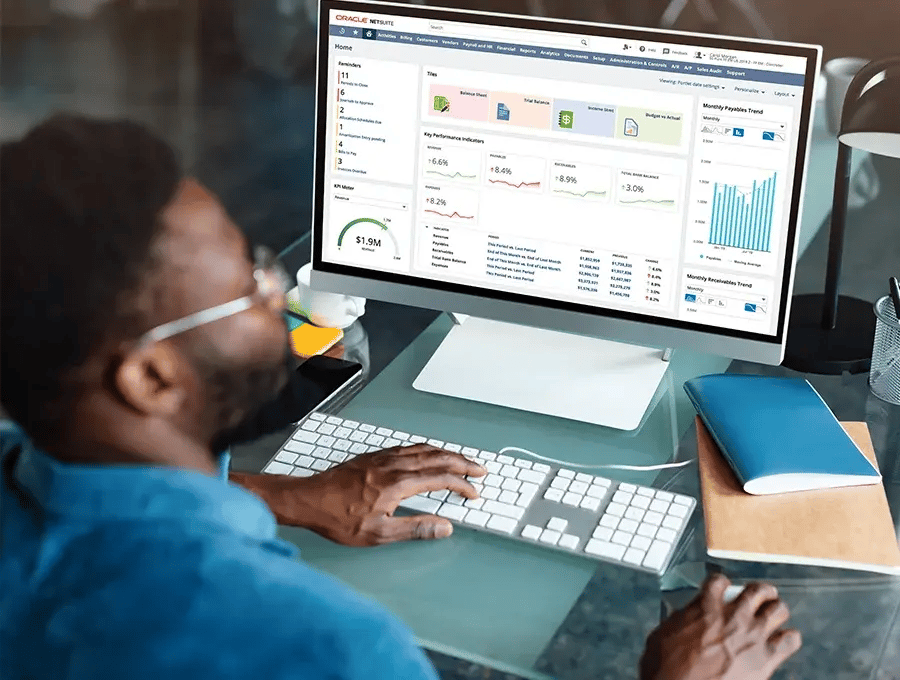
Man using NetSuite dashboard

What business problems does NetSuite solve?

As businesses grow, the systems and processes that worked when they were smaller can become harder to manage. NetSuite brings your financial and operational processes together, using automation and built-in AI capabilities to reduce manual work, improve visibility and help your team make better use of the information in your ERP.

Time lost to repetitive processes

Automate repetitive processes and reduce the duplicate entry that comes with managing data across disconnected systems.

Information scattered across the business

Bring financial and operational information together so teams aren't working from different versions of the truth.

Slow access to business insights

Give your team timely access to the information they need to understand what's happening across the business and make informed decisions.

Growing operational complexity

Manage inventory, purchasing, orders, fulfillment and other core processes in one connected system.

Financial management getting harder

Get better visibility into financial performance and simplify reporting, month-end close and other core finance processes.

More entities, locations and processes to manage

Support additional locations, entities, products and processes as your business grows without having to replace your core ERP system.

Is NetSuite right for your business?

Based on our experience, NetSuite is an especially strong fit for growing product-based businesses with increasing operational complexity, including manufacturers and distributors. But the right fit depends on more than industry. These are some of the other signals we look for when assessing whether NetSuite makes sense for your business.

NetSuite is a good fit when…

  • You’re relying on disconnected systems, spreadsheets and duplicate entry to get the work done.
  • You don’t have an easy way to see how the business is performing.
  • You operate across multiple locations, legal entities or divisions.
  • You’re planning to grow with new locations, markets, acquisitions or product lines.
  • You’re looking for a platform that can support more of your business as your requirements evolve.

NetSuite may not be a good fit when...

  • You don't manage inventory and only need basic invoicing, expense management and financial reporting.
  • Your priority is finding the lowest-cost software option.
  • Your current systems work well and significant growth isn't in the plan.
  • You have highly specialized processes that are better supported by an industry-specific solution.
  • You lack the time or internal resources to support an ERP project and the ongoing change that comes with it.

Frequently Asked Questions

How much does NetSuite cost?

NetSuite pricing depends on the functionality, users and implementation work your business requires. Our customers typically spend $120,000 to $500,000 for first-year software and implementation, but it could be above or below that range. Check out our NetSuite pricing page to see where your business may fall.

Is NetSuite a good fit for a small business?

It can be. Business complexity matters more than revenue or employee count. NetSuite is worth considering if you’re growing, managing inventory or outgrowing disconnected systems and spreadsheets. Learn more about who NetSuite is best for.

What’s the difference between NetSuite and QuickBooks?

QuickBooks is an accounting software. NetSuite connects accounting and operations (inventory, purchasing, sales, etc.) and reporting in one platform. Businesses often make the move when QuickBooks and connected spreadsheets or applications can no longer support their needs. See our full NetSuite vs. QuickBooks comparison for more detail.

How long does it take to implement NetSuite?

A tailored NetSuite implementation typically takes six to nine months, although complex projects can take longer. Companies with straightforward requirements may be able to use a preconfigured SuiteSuccess approach and go live in as little as 100 days. Learn more about what impacts your NetSuite implementation timeline.

How does NetSuite compare to other ERP systems?

NetSuite stands out for its cloud-native architecture, broad functionality and ability to support more business requirements within one platform before requiring integrations. But every ERP has strengths and tradeoffs, and the right choice depends on your processes, requirements and long-term plans. Explore the top NetSuite competitors.

Can NetSuite integrate with our existing systems?

Yes. NetSuite can connect with ecommerce, CRM, payroll and other business applications. The right approach depends on which systems need to stay, how information should move between them and whether a standard connector is available. Learn more about NetSuite integration.

Can NetSuite be customized?

Yes. NetSuite can be configured with fields, roles, workflows and reports, or extended through integrations and custom development. The best approach is to use standard functionality where it works and customize only when there’s a clear business reason. Learn more about NetSuite customization.

Does NetSuite include AI?

Yes. NetSuite uses embedded AI to automate repetitive work, identify trends and help users find and understand business information. Read about the AI capabilities available in NetSuite.

Still evaluating NetSuite?

Every business is different. A quick conversation with one of our NetSuite experts can help you understand whether NetSuite is the right fit, what your implementation might involve and where your investment is likely to fall.

Talk to a NetSuite ExpertSee NetSuite Articles
Woman with laptop and dashboard metrics